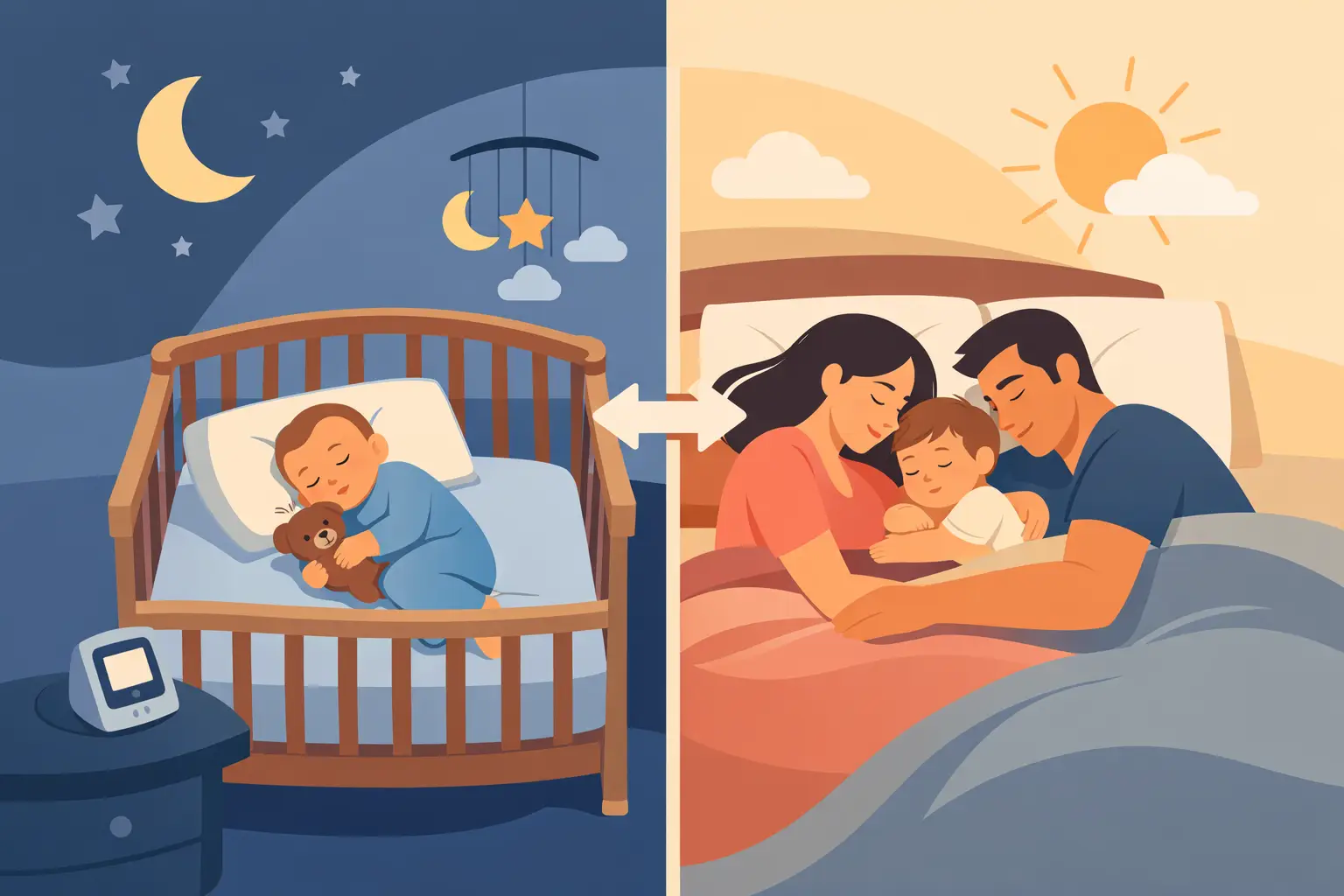
At 2:13 a.m., philosophy goes out the window. You are not debating parenting ideals. You are trying to survive another broken night, calm your baby, and figure out what will actually work tomorrow. That is why sleep training vs co sleeping feels so loaded. It is not just a sleep choice. It is a decision about safety, sanity, attachment, consistency, and how much disruption your household can realistically absorb.
Here is the truth most exhausted parents need to hear: neither approach is automatically better. The right choice is the one that is safe, sustainable, and repeatable in your real life – not your ideal life.
Sleep training vs co sleeping: the real difference
Sleep training is a structured method that teaches a baby to fall asleep with less help from a parent. Depending on the method, that can mean gradual check-ins, fading parental support, or more direct behavioral change. The goal is not emotional distance. The goal is independent sleep skills.
Co sleeping usually refers to sleeping in close proximity to your baby, though parents often use the term loosely. Some mean room sharing. Others mean bed sharing. That distinction matters because the safety profile is not the same. Room sharing means your baby sleeps in the same room on a separate sleep surface. Bed sharing means your baby sleeps in the adult bed with you.
Parents are often not choosing between two theories. They are choosing between two kinds of relief. Sleep training aims to create a predictable long-term system. Co sleeping often offers fast short-term settling, especially when a baby wakes frequently and the parent is too depleted to keep standing up all night.
Why parents choose co sleeping
Co sleeping usually starts as a survival move, not a manifesto. Feeding is easier. Settling can happen faster. Some babies clearly sleep longer when they are close to a parent, and some parents feel more connected and less stressed when they can respond immediately.
There is also a cultural and emotional layer. For many families, close sleep feels intuitive. It can align with breastfeeding, high responsiveness, and a parenting style centered on proximity. If the arrangement is working, everyone is rested, and safety is being handled appropriately, parents may see no reason to change.
But this is where clear thinking matters. What works at 8 weeks may stop working at 8 months. A setup that feels manageable during one phase can become disruptive once a baby becomes more alert, mobile, or dependent on one exact condition to go back to sleep.
Co sleeping can create real strain if one parent sleeps lightly, if the baby wakes to check for constant contact, or if the family wants more bedtime independence and cannot get it. Many couples also feel the impact on their relationship, especially when the bedroom stops functioning as a place for rest and reconnection.
Why parents choose sleep training
Sleep training appeals to parents who need stability. If bedtime is taking 90 minutes, night wakings are constant, naps are unpredictable, and everyone is unraveling, a structured plan can change the emotional climate of the entire house.
This is not about being cold or rigid. It is about replacing chaos with a proven method. Babies thrive on patterns. Parents do too. When a child learns a repeatable sleep routine, nights often become less dramatic, mornings become more manageable, and daily behavior improves because overtiredness stops driving everything.
The trade-off is that sleep training requires consistency. You cannot apply it one night, abandon it the next, then expect clean results. There is usually a short-term adjustment period, and some babies protest change. That is hard. But for many families, a few difficult nights are far easier than months of fragmented sleep and escalating dependency.
The safety question you cannot ignore
If this conversation includes bed sharing, safety has to come first. Not preference. Not online opinions. Safety.
Room sharing on a separate, baby-safe sleep surface is broadly considered the safer option for infants. Bed sharing carries additional risk, especially with soft bedding, couches, pillows, smoking exposure, parental exhaustion, alcohol use, sedating medications, or a very young or premature baby.
That does not mean every family discussing co sleeping is reckless. It means you need to be brutally honest about conditions, not sentimental about them. Many dangerous sleep setups happen by accident when an exhausted parent feeds a baby in bed or on a couch and falls asleep unintentionally. If sleep deprivation is pushing you into unsafe habits, that is not a neutral issue. It is a signal that your current system needs to change.
What actually works best depends on these five factors
The first is your baby’s age and temperament. A highly alert baby who depends on motion, feeding, or contact to stay asleep may respond very differently than a more adaptable baby. Some babies need a gentler transition. Others do surprisingly well once a clear routine is in place.
The second is your own level of exhaustion. If you are so depleted that you cannot follow through, even the best plan will collapse. The best method is the one you can execute consistently for several days, not the one that sounds ideal on paper.
The third is whether your current setup is improving or degrading sleep over time. If co sleeping is genuinely helping everyone rest, that matters. If it started as a rescue strategy and now every wake-up requires full parental involvement, that matters too.
The fourth is your household stability. In homes already stretched by postpartum recovery, work demands, older kids, ADHD, or relationship tension, chronic night disruption hits harder. Sleep is not a side issue. It affects mood, patience, conflict, and your ability to function.
The fifth is your long-term goal. Do you want your child in your room for now, or do you want independent sleep in the near future? If your current habit is moving you away from your actual goal, it is time to stop reacting and start leading.
A practical decision framework for sleep training vs co sleeping
Use this standard: safe, effective, sustainable.
Safe means the sleep arrangement does not rely on risky improvisation. Effective means your baby is actually sleeping well enough, not just falling asleep quickly and waking all night. Sustainable means you can keep doing it without resentment, burnout, or constant renegotiation.
If your current setup fails one of those three tests, it needs adjustment.
If co sleeping is safe, everyone is resting, and you are happy with it, you do not need to let outside pressure make your decision for you. If it is not sustainable and you are starting every night already tense, that is your answer.
If sleep training fits your goal, choose a method you can hold with confidence. Do not mix five strategies because panic set in after one rough bedtime. Pick a clear routine, control the sleep environment, and give the process enough time to work.
How to transition without creating more chaos
If you are moving away from co sleeping, do not make the shift vague. Babies respond better when the environment and expectations get clearer, not more emotional. Tighten bedtime. Use a predictable sequence. Put the baby down in the same place each night. Decide in advance how you will respond to wakings.
If you want a gentler approach, fade support gradually. Reduce feeding to sleep, reduce rocking, reduce parental presence in stages. If your child gets more activated by partial help, a more direct method may actually be kinder because it is cleaner and less confusing.
If you are moving toward co sleeping or room sharing because nothing else is working, make the choice deliberately. Do not drift into unsafe sleep because you are desperate. Build a setup that protects your baby first, then evaluate whether it is truly solving the problem or just delaying one.
The emotional pressure around this topic is real
Few parenting decisions attract more judgment than sleep. One side warns about dependence. The other warns about disconnection. Meanwhile, you still have to function tomorrow.
Take the emotion out of the decision and put evidence and reality back in. A good sleep plan should lower stress, not perform for other people’s approval. Your baby needs a regulated parent more than a parent trying to win a debate.
That is also why fast, structured action matters. Families do not need more vague reassurance. They need a blueprint they can follow under pressure. When a method is evidence-based, specific, and realistic enough to use in the middle of the night, progress happens faster.
The best choice is not the one that sounds pure. It is the one that helps your baby sleep safely and helps your home feel steady again. If that means co sleeping for a season, own it. If that means sleep training because your family needs relief, own that too. Clear decisions create calm. And calm is what lets good parenting come back online.
Leave a Reply