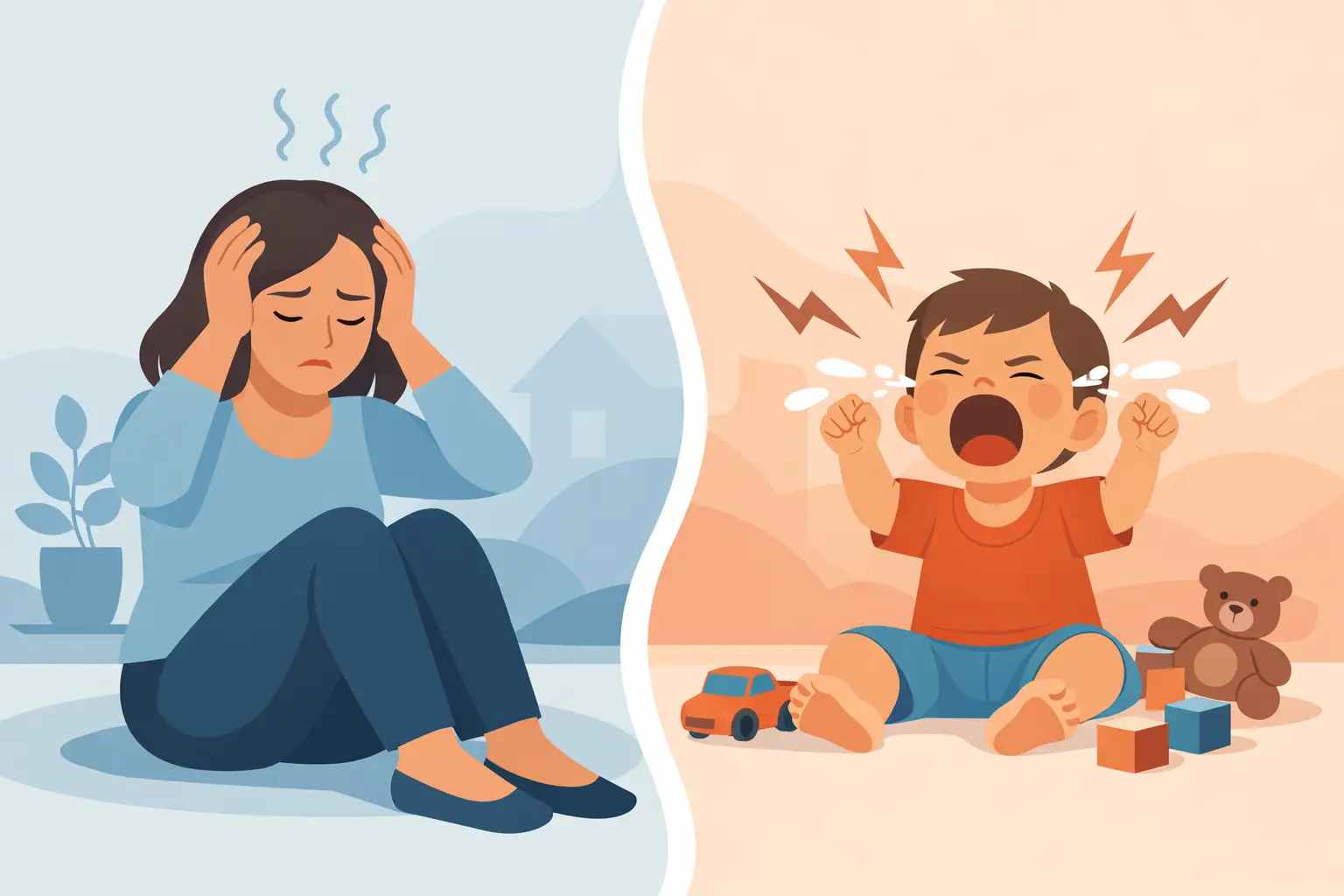
The scream usually hits at the worst possible moment – in the car, in the checkout line, during dinner, or right when you finally sit down. If you’re asking, why does my toddler scream, you’re probably not looking for vague reassurance. You want to know what’s causing it, what it means, and what to do tonight to make your home feel calmer.
Here’s the truth. Toddler screaming is common, but that does not mean you have to just tolerate it and hope they grow out of it. Screaming is a signal. Your job is not to fear it or shut it down with panic. Your job is to decode it fast, respond strategically, and stop the pattern from taking over your house.
Why does my toddler scream? Start with the real reason
Toddlers scream because they do not yet have the skills to handle big feelings, frustration, sensory overload, or unmet needs in a controlled way. Screaming is often not defiance first. It is communication first.
That said, the reason matters. A toddler who screams because he is exhausted needs a different response than a toddler who screams because screaming now gets him a snack, your phone, or total control of the room. Parents get stuck when they treat every scream like the same problem.
In most cases, toddler screaming falls into one of two buckets. It is either driven by dysregulation or reinforced by patterns. Sometimes it is both.
Dysregulation means your child’s system is overloaded. They are hungry, tired, overstimulated, uncomfortable, or emotionally flooded. Reinforced behavior means they have learned, often accidentally, that screaming produces a result. That result might be attention, escape, a delayed limit, or the exact thing they wanted.
When you can identify which bucket you’re dealing with, your next move gets much easier.
The most common triggers behind toddler screaming
Hunger and fatigue sit at the top of the list. A tired toddler has almost no margin. A hungry toddler has even less. If the screaming spikes before meals, after daycare, late in the afternoon, or close to bedtime, your first step is not discipline. It is prevention.
Frustration is another major trigger. Toddlers understand far more than they can express. They want independence, but their motor skills, language, and patience are still limited. When they cannot open the cup, put on the shoe, or make you understand what they want, screaming can become the fastest outlet.
Sensory overload is easy to miss. Some children scream more in noisy stores, crowded family gatherings, bright spaces, or after too much screen time. Their nervous system gets flooded, and the scream is the overflow valve. If your child melts down more in stimulating environments, this matters.
Then there is the limit-setting scream. This happens when you say no, stop a preferred activity, remove an object, or ask them to transition. The scream here is often about control. Not because your toddler is manipulative in an adult sense, but because toddlers are wired to test where the boundary actually holds.
Pain and discomfort can also show up as screaming. Ear infections, teething, constipation, illness, itchy clothing, and sleep disruption all raise the volume fast. If the screaming feels sudden, intense, or out of character, rule out a physical cause.
When screaming is developmentally normal – and when it’s not
Some toddler screaming is a normal part of development. Between roughly ages 1 and 3, children are learning emotional regulation from scratch. Their brains are still building the ability to pause, tolerate frustration, and recover without going full alarm mode.
Normal does not mean pleasant. It means expected.
What deserves a closer look is screaming that is extreme, prolonged, increasing sharply, or paired with developmental concerns like language delay, major sensory sensitivity, social withdrawal, frequent aggression, or an inability to calm even with strong support. If your gut says this is more than typical tantrum behavior, trust that signal and talk with your pediatrician.
You do not need to catastrophize every outburst. But you also do not need to ignore a pattern that feels bigger than everyday toddler behavior.
What to do in the moment when your toddler screams
First, regulate yourself. If you meet a toddler’s scream with your own raised voice, frantic threats, or visible panic, the chaos multiplies. Calm is not weakness here. Calm is control.
Get low, keep your words short, and reduce stimulation. A long lecture will not land in the middle of a meltdown. Use a firm, steady tone. Try: “You’re upset. I’m here. We’re not screaming at people.” Then stop talking so much.
If the scream is coming from overload, lower the demands. Move to a quieter space. Offer water. Hold the boundary, but remove extra pressure. If the scream is coming from a denied request, do not negotiate your limit just because the volume went up. That teaches the exact lesson you do not want taught.
This is where many parents accidentally train more screaming. They say no, the child screams, and then they hand over the snack, screen, toy, or exception just to end the scene. That may buy two minutes of peace, but it strengthens the pattern.
Your goal is simple. Comfort distress without rewarding the scream.
That might sound like this: “I hear you. The answer is still no.” Or: “When your voice is calm, I can help.” Direct. Predictable. No drama.
Why does my toddler scream more with me than with other people?
This question stings, but the answer is usually not that your child hates you or that you are failing. Toddlers often scream more with their safest person because that is where they release what they’ve been holding in.
There is also a second layer. Children learn quickly which adult is most likely to bend under pressure. If your toddler screams more with you than with your partner, sitter, or grandparent, it may be because your child experiences you as both safe and negotiable.
That is not a character flaw. It is a pattern problem.
If your responses change day to day depending on your stress level, your toddler will keep testing until the rules feel clear. Consistency lowers screaming because predictability lowers emotional escalation.
The fastest way to reduce screaming over time
You will not eliminate toddler screaming with one perfect phrase. You reduce it by changing the system around it.
Start by tracking when it happens. Not forever – just for three days. Look for timing, transitions, environments, and predictable battles. Most parents see a pattern much faster than they expect. Once you know the trigger points, you can act earlier.
Build in preemption. If late afternoon is the danger zone, use a snack, quiet reset, and simpler expectations before the spiral starts. If leaving the park always causes a scream, prepare the transition before it hits. Give a warning, use the same exit phrase every time, and follow through.
Then tighten your boundaries. If screaming has become a tool for getting results, decide in advance what will no longer be negotiated. Not harshly. Clearly. A toddler does not need a more emotional parent. A toddler needs a more predictable one.
Finally, reward the behavior you want more of. Catch the calm ask, the recovered moment, the tiny effort at using words. Parents often pour all their energy into reacting to the worst behavior and almost none into reinforcing the better one. That keeps everyone stuck.
If your toddler screams daily, don’t wait for it to get worse
Frequent screaming is exhausting. It drains your patience, disrupts sleep, strains your relationship, and makes basic errands feel impossible. If you are at the point where every day feels like damage control, you do not need more theory. You need a repeatable method.
That is exactly where a psychology-backed framework helps. Instead of guessing whether this scream is hunger, habit, overstimulation, or boundary testing, you learn how to identify the trigger, respond without feeding the cycle, and build calmer behavior fast. Emily Carter-Wells’ approach is built for parents who need results, not endless advice.
And if you’re worried that responding firmly will make things worse, remember this: toddlers feel safer when the adult is steady. Not louder. Not harsher. Steadier.
A screaming toddler is not proof that your home is broken. It is proof that your child needs stronger regulation support, clearer limits, or both. Once you stop treating every scream like an emergency, you can start treating it like data – and that is when the chaos begins to lose its grip.
Leave a Reply