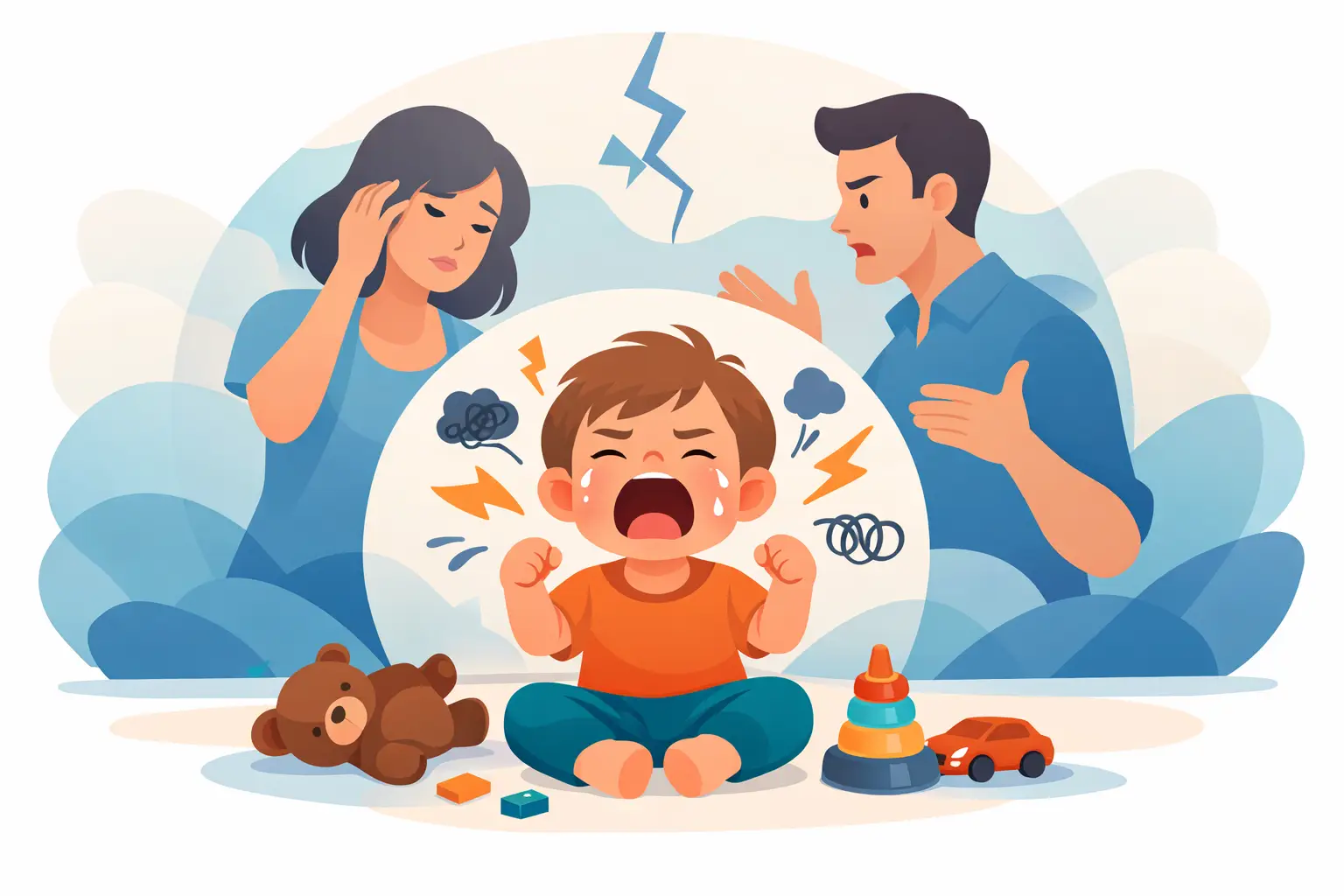
You said no to the blue cup, and now your toddler is on the kitchen floor screaming like the world just ended.
That does not mean you are doing parenting wrong. It means you are dealing with a nervous system problem, not a character problem. If you want calmer days, you need to stop treating meltdowns like defiance and start reading them like overload.
What causes toddler meltdowns?
The short answer is this: toddler meltdowns happen when a young child is hit with more emotion, frustration, stimulation, or fatigue than their developing brain can handle in that moment.
Toddlers do not have mature impulse control. They do not have strong emotional regulation. They do not have the language to clearly explain what is wrong before the situation explodes. When pressure builds faster than their skills can keep up, the meltdown shows up.
That is why smart, loving, well-parented toddlers still fall apart over small things. The cracker broke. The sock feels wrong. You buckled the car seat too soon. These moments look irrational to adults, but they are often the final trigger on top of an already overloaded system.
If you have been asking what causes toddler meltdowns in your home, the answer is usually not one single thing. It is a stack of factors.
The 7 biggest meltdown drivers
1. Overtiredness
Fatigue is one of the fastest routes to chaos. A tired toddler has less frustration tolerance, weaker listening skills, and a much lower threshold for disappointment.
This is why meltdowns often spike late afternoon, before naps, after bad sleep, during travel, or in seasons of schedule disruption. If your child is melting down over things they usually handle well, sleep debt may be the real problem.
Parents often miss this because they focus on the visible trigger. The toy was taken away. The snack was denied. But the real issue may be that the child had already been running on empty for hours.
2. Hunger and blood sugar crashes
A hungry toddler is rarely a reasonable negotiator. When blood sugar drops, patience drops with it.
This can create meltdowns that seem sudden and extreme. One minute your child is fine, the next they are sobbing because their banana peeled the wrong way. Again, the banana is usually not the full story.
This does not mean you solve every hard moment with snacks. It does mean you respect the biology. Regular meals and strategic snack timing can prevent a surprising amount of drama.
3. Overstimulation
Toddlers are still learning how to filter noise, activity, transitions, bright lights, crowded spaces, and constant input. A fun day can turn into a disaster simply because their system took in too much.
Birthday parties, errands, family gatherings, restaurants, and even a noisy home can push some children past their limit. This varies by child. One toddler is energized by busy environments. Another is flattened by them.
This is where parents need nuance. If your child melts down after every packed day, the issue may not be behavior. It may be sensory overload.
4. Frustration without the skills to express it
Toddlers want a lot of control and have very little power. They also have big ideas and limited ability. That gap creates frustration constantly.
They may want to zip the jacket but cannot. They may know what they mean but cannot find the words. They may want independence and still need help. That tension is fertile ground for meltdowns.
This is especially true during language growth spurts. A child who understands far more than they can say often gets overwhelmed quickly because their brain is ahead of their communication.
5. Transitions and loss of control
Toddlers do not usually melt down because a transition exists. They melt down because the transition feels abrupt, imposed, and out of their control.
Leaving the park, turning off the TV, getting into the bath, getting out of the bath, stopping play to eat dinner – these are classic flashpoints because they force a shift before the child feels ready.
Young children thrive on predictability. When life feels like adults constantly moving them from one thing to the next, resistance climbs. A meltdown can become their last available tool to protest the change.
6. Big feelings they cannot regulate yet
Toddlers feel emotion intensely. Excitement, disappointment, jealousy, fear, embarrassment, anger, and sadness can all hit hard and fast.
Adults often label only angry outbursts as meltdowns, but many meltdowns begin with grief or overwhelm. A sibling gets attention. A parent leaves the room. A routine changes. A favorite object is missing. The child does not calmly process the disappointment. Their body reacts.
This matters because your response changes everything. If you treat a flooded child like a manipulative child, you often escalate the episode.
7. Inconsistent boundaries
This one is harder to hear, but it matters. Sometimes meltdowns get stronger because the environment is inconsistent.
If a child sometimes gets the candy after screaming, sometimes gets ignored, sometimes gets a lecture, and sometimes gets a parent who explodes, the pattern becomes unstable. Unstable patterns increase testing, anxiety, and emotional intensity.
Clear boundaries do not cause more meltdowns long term. They reduce confusion. At first, consistency can bring pushback because your child notices the system changed. But over time, predictable limits create safety.
Why meltdowns happen more with parents
Many parents quietly wonder why daycare says their child was “great all day” while home feels like a battlefield.
That is normal. Toddlers often unravel most with the adults they trust most. Home is where they release accumulated stress. It is also where boundaries are most emotionally loaded because attachment is strongest.
This does not mean your child is targeting you in a calculated way. It means you are their safest place to fall apart. That truth can be painful, but it is also useful. When you stop taking meltdowns personally, you can respond with much more control.
What causes toddler meltdowns to get worse?
The original trigger matters, but escalation is usually shaped by the adult response.
Fast talking, repeated commands, threats, lectures, arguing, and trying to force logic into a dysregulated moment usually backfire. A toddler in full meltdown is not in a learning state. They are in a survival state. Their brain is not ready for a speech about choices and consequences.
This does not mean you give in. It means you shift your goal. In the peak of the storm, the goal is regulation first, teaching second.
It also helps to stop asking too many questions in the moment. “Why are you doing this?” and “What is wrong with you?” add pressure. A calmer script is more effective: “You’re upset. I’m here. We’re going to get calm first.”
The control method: prevent, spot, respond
If you want fewer meltdowns, use a simple three-part framework.
First, prevent what you can. Protect sleep, keep meals predictable, reduce unnecessary transitions, and build in decompression after overstimulating events. Prevention is not weakness. It is high-leverage parenting.
Second, spot the early signs. Most toddlers do not go from calm to chaos in one second. They get whiny, rigid, clingy, loud, impulsive, or impossible over small things. That is your warning window. Move in early with co-regulation, not correction.
Third, respond without feeding the fire. Stay close, keep language short, hold the boundary, and lower the emotional temperature. If the answer is no, let it stay no. If your child is overwhelmed, help their body settle before trying to teach the lesson.
This is where evidence-based parenting beats guesswork. You do not need more guilt. You need a repeatable system.
When to look deeper
Most toddler meltdowns are developmentally normal. Still, context matters.
If meltdowns are unusually intense, very long, happening many times a day, tied to major sensory issues, paired with sleep disruption, or accompanied by language delays or aggressive behavior far beyond typical toddler frustration, it may be worth a deeper evaluation. Sometimes what looks like “bad behavior” is a sign of an unmet developmental or sensory need.
The goal is not to panic. The goal is accuracy. The better you understand the driver, the faster you can make effective changes.
If you want structured, fast-acting tools for behavior and household calm, resources like the parenting frameworks at Emily Carter-Wells are built for exactly this kind of high-stress pattern interruption.
Your toddler is not giving you a hard time. Most days, they are having a hard time in a small body with limited skills. When you identify the real cause instead of fighting the surface behavior, you take back control and give your child something even more valuable – a calmer path back to regulation.
Leave a Reply