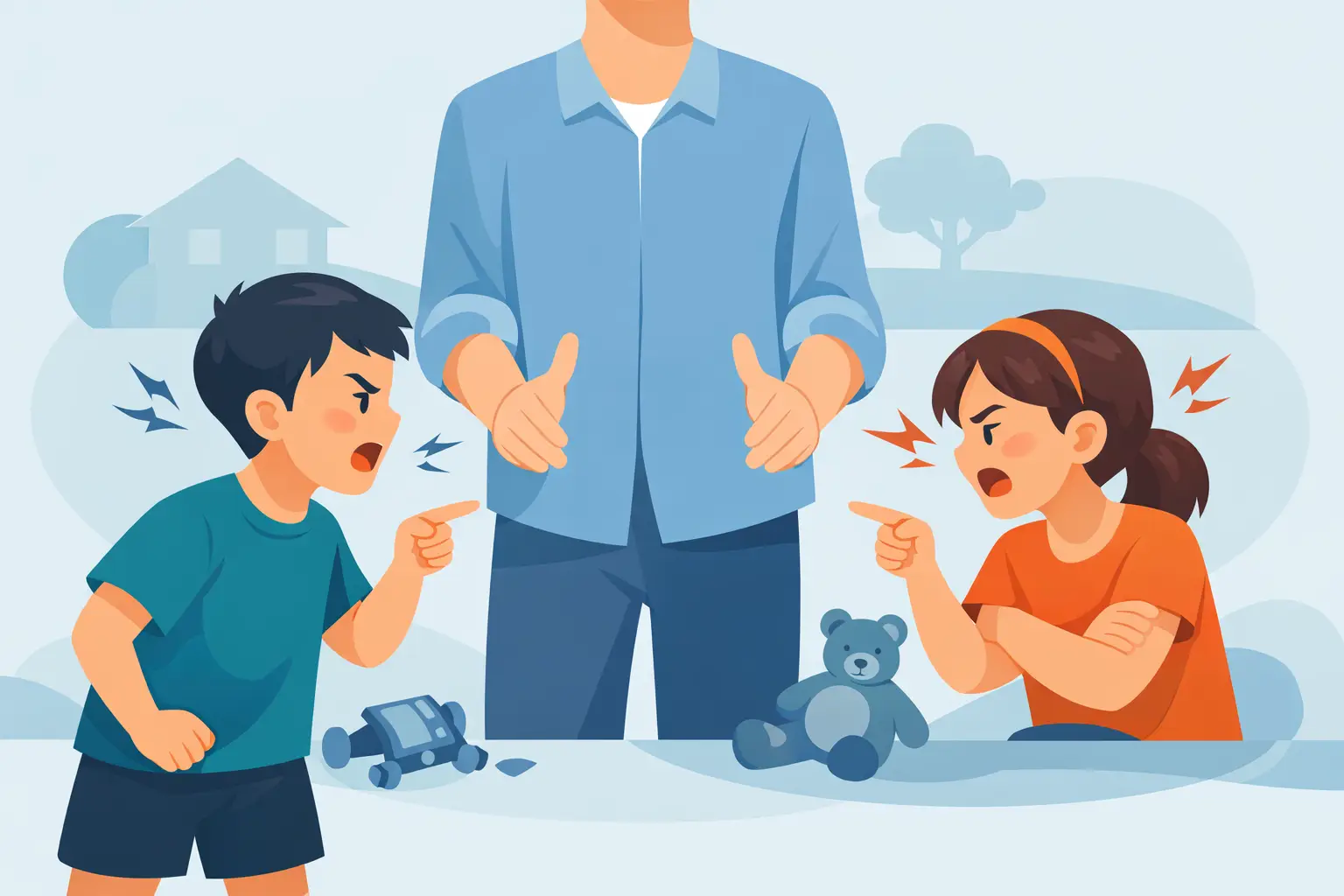
The fight usually starts over nothing.
A look. A toy. Who sat in the “wrong” spot. Then suddenly one child is screaming, the other is denying everything, and you are standing in the kitchen thinking, I cannot do this ten more times today.
You can. But not with more yelling, more lectures, or more empty warnings. If you want to know how to stop sibling fighting, you need a system that lowers conflict at the source. Fast relief comes from structure, not speeches.
Why sibling fights keep happening
Most sibling conflict is not random. It follows a pattern. Children fight when the environment rewards competition, when boundaries are unclear, when one child feels chronically powerless, or when both kids have learned that conflict gets immediate attention.
That does not mean you caused it. It means there are leverage points you can control.
Parents often make the same understandable mistake. They wait until the fight explodes, then try to solve it in the heat of the moment. That almost never works. A dysregulated child is not in learning mode. An offended sibling is not interested in fairness. And a stressed parent usually defaults to repeating the same phrases that have already lost power.
The goal is not to make siblings love every minute together. That is not realistic. The goal is to stop the chaos, reduce the frequency and intensity of fights, and teach your children how to recover without turning your home into a battleground.
How to stop sibling fighting by changing the pattern
Start with one principle: do not treat every fight like a separate emergency. Treat it like a repeated system failure.
When you shift from reaction to prevention, everything gets clearer. You stop asking, “Who started it?” and start asking, “What setup keeps producing this result?” That question gives you power.
There are four high-leverage areas to fix: predictability, separation, coaching, and consequences. If even one of these is missing, conflict keeps recycling.
1. Increase predictability before conflict starts
Sibling fights spike during transitions, boredom, hunger, fatigue, and unstructured shared time. In plain language, kids fight more when they do not know what is happening next or when they have too much access to each other without enough support.
Set clearer rhythms. If after-school time is always rough, build a routine that removes decision fatigue. Snack first. Quiet time second. Shared play later. If mornings are the danger zone, separate tasks and reduce unnecessary contact until everyone is dressed and fed.
This is not over-parenting. It is smart behavioral management. Children do better when the environment does more of the work.
2. Stop forcing too much togetherness
Many parents assume siblings should learn to work it out by spending more time together. Sometimes the opposite is true.
If your kids are in a high-conflict season, give them strategic separation. Separate play spaces. Separate seats in the car. Separate turns with high-value toys. More physical and emotional space often reduces friction immediately.
This is especially important when there is a large age gap, a temperament mismatch, or one child is more rigid, impulsive, or easily overstimulated. Equal treatment is not always effective treatment. Give each child what helps them succeed.
3. Coach skills when nobody is mad
Do not save all teaching for the fight itself. If you want better behavior under pressure, rehearse the skill outside the pressure.
That means practicing what to say instead of grabbing. Practicing how to ask for a turn. Practicing how to walk away. Practicing how to get a parent without tattling for sport.
Keep it short and direct. “Say, ‘I am using that. You can have it when I am done.’” Or, “If your brother is bothering you, your job is to move your body first, not hit first.” These are concrete scripts. Children can actually use them.
Long moral lessons fail because they are too abstract. Specific replacement behaviors win.
4. Use consequences that target the real problem
If the same fight happens every day, your consequence is not strong enough, not clear enough, or not connected enough to the behavior.
Consequences should be immediate, boring, and predictable. If a child cannot handle shared crayons without screaming, the crayons get removed for a period of time. If rough physical behavior starts during couch play, couch play ends. If both children escalate instead of using words, both lose access to the activity.
That last part matters. Parents often get stuck trying to deliver courtroom justice in five seconds. You do not need a legal trial. You need household order. If both children contributed to the chaos, both can lose the privilege.
What to do in the moment when a fight breaks out
This is where most parents either regain control or accidentally feed the cycle.
First, regulate the room. Lower your voice. Move your body between the children if needed. Separate first, investigate second. Safety before fairness.
Second, do not demand instant apologies. Forced apologies under stress are performative. They do not build empathy, and kids know it. Focus on stopping the behavior and resetting nervous systems.
Third, keep your words short. “Stop. Separate. Hands down.” Then deal with each child one at a time. The more you talk into chaos, the less your words matter.
Fourth, avoid turning one child into the permanent villain and the other into the permanent victim. That family role assignment becomes its own problem. Even when one child is more aggressive, each child needs accountability without identity damage.
A better script sounds like this: “I will not let you hit. You are taking a break.” Then later: “Next time, use your words or leave the room. Hitting loses the activity every time.” Clear. Calm. Final.
The mistake that keeps parents stuck
The biggest mistake is inconsistency.
If some days you ignore teasing, some days you explode, and some days you negotiate for twenty minutes, your children learn that conflict is a variable-reward machine. And variable rewards are powerful. They keep behavior alive.
Your job is not to produce a perfect response. Your job is to produce a repeatable one.
That means your household needs a simple conflict plan. For example: no hitting, no name-calling, no grabbing. If those happen, separation is immediate and the activity ends. If children want the item, they use a turn system. If they cannot recover, they lose access to shared play for the rest of that block of time.
You do not need twenty rules. You need a few proven methods enforced every single time.
When sibling fighting means something deeper
Sometimes sibling conflict is not just ordinary rivalry. It may be intensified by ADHD, sensory overload, anxiety, sleep deprivation, major life changes, or one child feeling repeatedly compared, corrected, or overlooked.
This is where nuance matters.
If one child has impulse control challenges, a lecture about kindness will not solve a neurological regulation issue. If one child is constantly invading space because they crave connection, pure punishment may increase the behavior. If a younger child keeps ruining an older sibling’s things, the answer may be better protection of property, not just repeated reminders to share.
Behavior always tells a story. You do not need to overanalyze it, but you do need to respect it.
That is why fast results usually come from a mix of firm boundaries and better diagnosis. Not every child needs the same correction. One may need tighter supervision. Another may need more one-on-one attention. Another may need fewer opportunities for conflict in the first place.
How to stop sibling fighting without becoming the referee all day
The end goal is not parental micromanagement. It is self-control.
To get there, reduce the number of fights you fully mediate. For lower-level conflict, coach once and step back. “You both want the same toy. Solve it with turns or it goes away.” That teaches responsibility. But do not step back from aggression, intimidation, or repeated targeting. Those need strong adult intervention.
It helps to notice which problems are “kid-sized” and which are not. Mild frustration, competing preferences, and short disputes can become learning opportunities. Physical aggression, humiliation, and relentless provocation are too big to leave to children.
If your home has been tense for a while, expect resistance at first. Children often push harder when the system changes because they are testing whether you mean it. Stay steady anyway. Calm authority feels different from chaos, and kids usually trust it faster than they show it.
If you want more structured, evidence-based family tools, Emily Carter-Wells offers practical blueprints designed to create noticeable household calm quickly.
You do not need your children to be best friends by Friday. You need fewer explosions, clearer limits, and a home that feels safe again. That starts with one decision: stop managing each fight like a surprise, and start leading your household like the pattern can change.
Leave a Reply