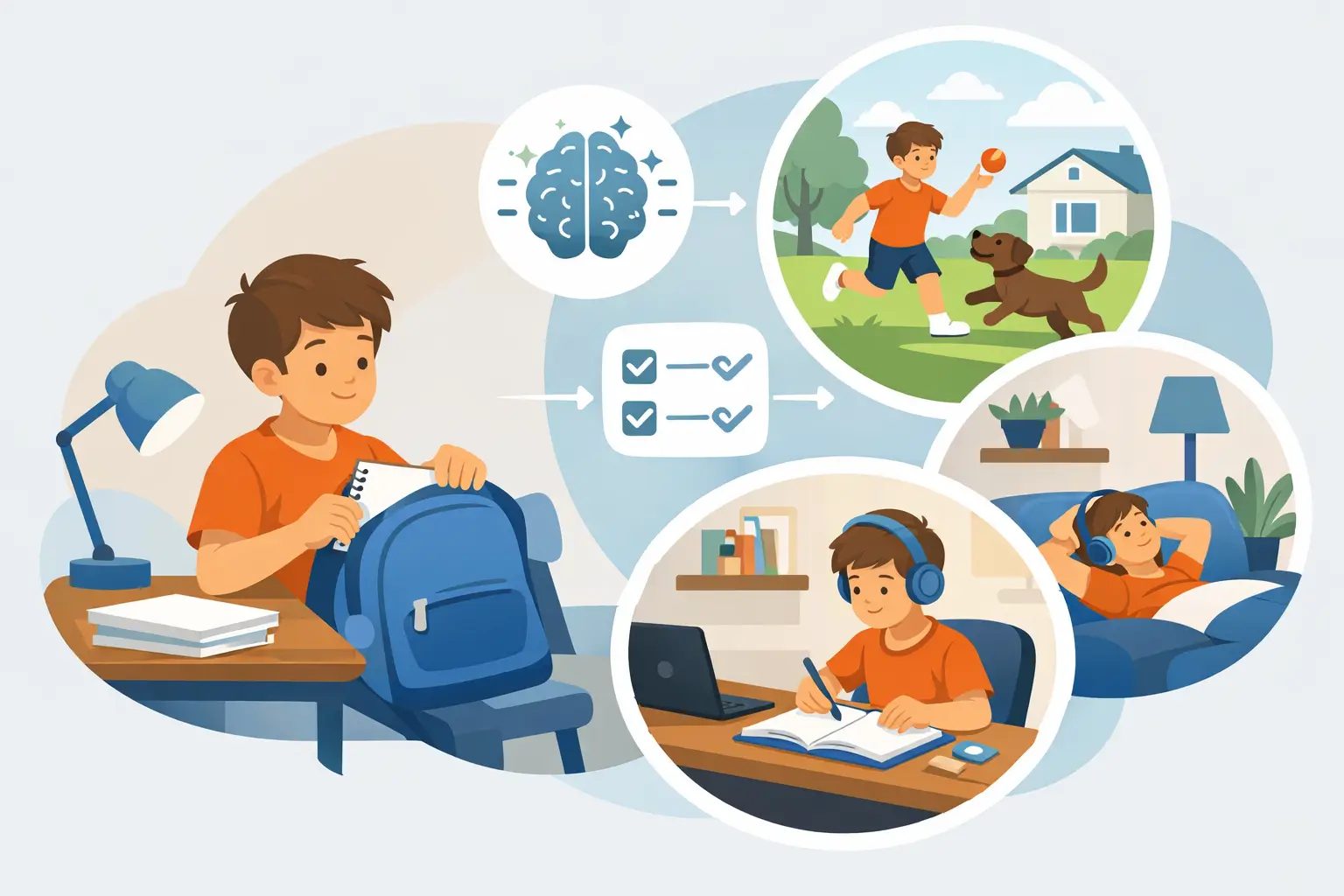
3:15 p.m. hits, your child walks through the door, and the whole house seems to tighten. Shoes get kicked off in the middle of the floor. A snack turns into a negotiation. Homework becomes a battle. By dinner, everyone is overstimulated, frustrated, and one small request can set off a full meltdown.
That pattern is common for ADHD, but it is not inevitable.
A strong after school routine for adhd child needs to do one thing first: lower the nervous system load before you ask for performance. Most parents are told to focus on compliance right away. That usually backfires. Your child has already spent hours managing noise, transitions, social pressure, academic demands, and self-control. By the time they get home, they are running on fumes.
If you want calmer afternoons fast, stop treating after school like a second school day. Build it like a recovery-and-reset system. That is what creates better behavior, smoother homework, and less evening chaos.
Why the after-school window gets so hard
ADHD kids often hold it together at school and fall apart at home. Parents misread that as manipulation, but the real issue is effort fatigue. School requires constant regulation – staying seated, tracking instructions, filtering distractions, switching tasks, managing emotions, and masking stress. Home is where the strain finally shows.
There is also a timing problem. Many children come home hungry, mentally depleted, and sensitive to demands. If medication is wearing off in the late afternoon, that adds another layer. A child who looked mostly regulated at 1 p.m. may be far more impulsive, emotional, or oppositional by 4 p.m.
That is why generic advice like “just be consistent” is not enough. Consistency matters, but the sequence matters more. If your routine starts with correction, homework pressure, or too many verbal directions, you are setting up a fight.
The 4-part after school routine for adhd child
The most effective routine is simple. Not easy, but simple. It has four phases: decompress, refuel, move, then work. This order is high-leverage because it respects how ADHD brains recover.
1. Decompress before you direct
The first 15 to 30 minutes after school should not start with questions, chores, or homework reminders. This is the reset window.
That does not mean unlimited screen time or total chaos. It means low-demand decompression. Some kids need quiet. Some need sensory input. Some need to pace, build with Legos, sit under a weighted blanket, listen to music, or simply not talk.
Your job here is to remove pressure, not remove structure. A simple script works well: “You’re home. First we reset, then snack, then movement, then homework.” That gives predictability without starting a power struggle.
If your child tends to explode the second they get home, reduce language even more. Too much talking can feel like one more demand. Use a visual schedule if needed. ADHD kids often respond better to what they can see than what they are told repeatedly.
2. Refuel early, not later
A lot of after-school conflict is really blood sugar plus exhaustion wearing an ADHD label.
Give a protein-forward snack early and make it automatic. When snack is predictable, you remove one major friction point. Think cheese and crackers, Greek yogurt, apple slices with peanut butter, turkey roll-ups, or a smoothie. The exact snack matters less than the routine around it.
Do not turn snack into a new decision battlefield. If your child struggles with transitions, offer two standard options and keep rotating from a short list. Too many choices can create more dysregulation, not less.
3. Use movement as treatment, not a reward
Many parents hold movement until after homework is done. For ADHD, that can be the wrong order.
Movement improves attention, mood regulation, and transition readiness. It can be 10 minutes on a trampoline, a scooter ride, basketball in the driveway, dancing in the living room, jumping jacks, walking the dog, or carrying groceries inside. What matters is that the body gets a chance to discharge stress.
If your child comes home wired, movement should be non-negotiable. Not as punishment. Not as something they have to earn. As part of the regulation blueprint.
There is one trade-off here. Some kids get more revved up with rough play or competitive sports right before homework. If that is your child, use calmer movement like walking, stretching, or a sensory circuit instead. The principle stays the same, but the intensity depends on the child.
4. Start work with a short win
Homework should not begin with the hardest subject, the longest worksheet, or your child’s weakest area. Start with a fast win to build momentum.
That might mean one easy page, five math facts, reading for eight minutes, or packing the backpack before starting written work. Momentum matters because ADHD brains often resist task initiation more than the task itself.
Use short work blocks. Ten to twenty minutes is realistic for many children, especially in elementary and middle school. Then give a brief break. A visual timer helps because it removes the constant “how much longer?” battle.
Keep your directions tight. One instruction at a time. “Get your folder.” Pause. “Open to the first page.” Pause. “Do numbers one through three.” Long explanations tend to create shutdown or distraction.
What parents should stop doing
If your afternoons feel explosive, there are usually a few hidden patterns making it worse.
First, stop front-loading demands the minute your child gets home. Questions like “How was your day?” can wait if your child is dysregulated. So can lectures about the behavior report from school.
Second, stop changing the plan every day. ADHD kids do better when the rhythm is boringly predictable. The routine does not need to be perfect. It needs to be repeatable.
Third, stop using threats as your main transition tool. “If you don’t start now, no screens all night” might get compliance sometimes, but it usually raises emotional intensity and burns trust. Calm authority works better than constant escalation.
Fourth, stop expecting verbal reminders to do all the work. If you are repeating the same instruction five times every afternoon, the system is weak. Add visual cues, timers, snack stations, backpack hooks, or a printed routine card.
How to make the routine stick within a week
You do not need a complicated chart with 14 steps. You need a system your family can actually run on a hard day.
Start by writing the routine in five words or less per step. For example: Home, Reset, Snack, Move, Homework. Post it where your child walks in. Then rehearse it when everyone is calm, not during a meltdown.
Keep the timing consistent for five school days before judging it. Parents often abandon a good routine too early because day one still looks messy. That is normal. New systems usually get tested before they get accepted.
Also, decide in advance what happens if your child resists. Not a huge punishment plan. Just a calm response. “This is the routine. First reset, then snack.” “This is the routine. First movement, then homework.” Predictable language reduces emotional leakage from the parent, and that matters more than most people realize.
If evenings are still rough, look at the pressure points. Is homework happening too late? Is the snack too light? Is decompression accidentally turning into an hour of overstimulating screen use? Is medication timing part of the issue? Sometimes the routine is not failing. It just needs one adjustment.
When an after-school routine needs more flexibility
There is no single perfect after school routine for adhd child because not all ADHD presentations look the same.
Some children need near-total silence for 20 minutes. Others regulate better through connection and want you nearby while they snack. Some can do homework before sports. Others will crash if they do not move first. Teenagers may need more ownership in building the schedule or they will reject it on principle.
That is not inconsistency. That is strategy.
The goal is not to control every minute. The goal is to reduce friction, lower stress, and create enough structure that your child can succeed more often than they spiral. That is how you take back the late afternoon without turning your home into a command center.
If you want faster implementation, the best approach is always the one you can repeat with confidence. At Emily Carter-Wells, that is the standard: proven methods, clear structure, and practical change you can feel quickly.
Your child does not need a perfect parent at 3:15 p.m. They need a predictable landing place. Build that, and the whole evening starts to change.
Leave a Reply